Description
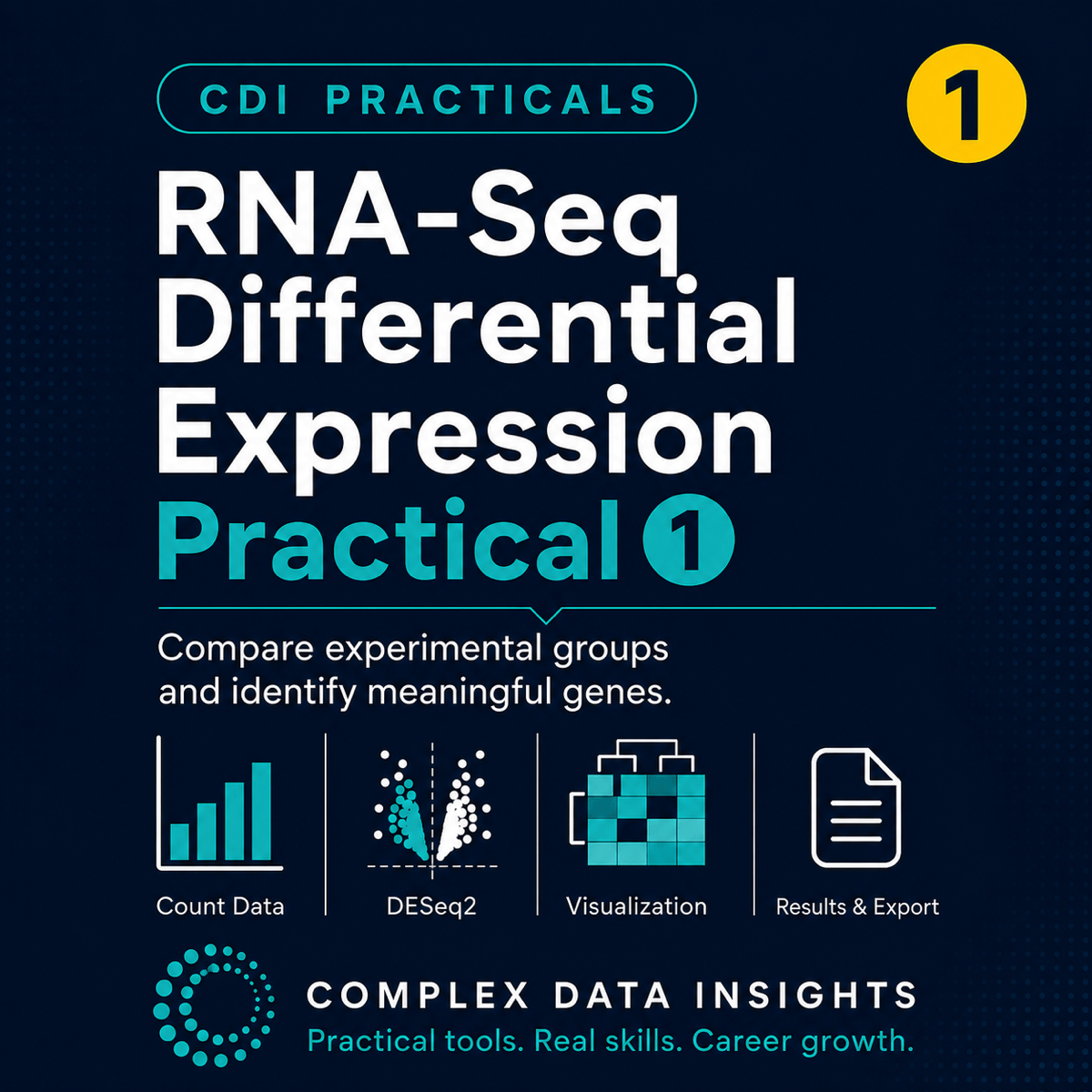
RNA-Seq Analysis Practical
A hands-on exercise for moving from RNA-Seq count data to differential expression results and biological interpretation
RNA-Seq analysis can feel difficult when statistical methods, code, visualizations, and biological interpretation are presented as separate topics.
This practical brings those steps together in one structured and reproducible workflow.
You will begin with a realistic RNA-Seq count matrix and sample metadata, inspect the dataset, prepare it for analysis, explore relationships between samples, identify differentially expressed genes, and interpret the resulting statistical evidence.
The practical is designed for learners, researchers, students, and early-career analysts who want to understand not only how to run an RNA-Seq analysis, but also how to explain what the results mean.
What you will practise
You will work through a complete RNA-Seq differential expression workflow that includes:
- importing an RNA-Seq count matrix and sample metadata
- checking sample names, experimental groups, and data structure
- examining sequencing library sizes
- filtering genes with very low counts
- normalizing count data using DESeq2
- exploring sample relationships with PCA and correlation analysis
- fitting a differential expression model
- comparing experimental conditions
- interpreting log2 fold changes, p-values, and adjusted p-values
- identifying statistically significant genes
- creating publication-ready figures
- exporting analysis results for reporting and further biological interpretation
Figures and outputs
During the practical, you will generate useful analysis outputs such as:
- a library-size plot
- a sample-correlation heatmap
- a PCA plot
- an MA plot
- a volcano plot
- normalized gene-expression counts
- complete differential expression results
- a table of significant differentially expressed genes
- a table of top-ranked genes
These outputs can be used as portfolio evidence, research documentation, teaching examples, or starting points for downstream functional enrichment analysis.
Statistical interpretation
The practical explains the key statistical concepts used in RNA-Seq differential expression analysis, including:
- effect size
- biological variability
- statistical uncertainty
- multiple-testing correction
- adjusted p-values
- significance thresholds
- the difference between statistical significance and biological importance
Rather than simply producing a list of genes, you will learn how to evaluate whether the findings are reliable, meaningful, and supported by the experimental design.
Tools used
The workflow is completed in R using widely used packages, including:
- DESeq2
- ggplot2
- dplyr
- readr
- pheatmap
- tibble
The practical starts from processed count data and sample metadata. Raw FASTQ processing, alignment, and read-level quality control are intentionally excluded so that you can focus on statistical analysis and interpretation.
Who this practical is for
This practical is suitable for:
- undergraduate and postgraduate students
- researchers beginning RNA-Seq analysis
- laboratory scientists working with sequencing results
- bioinformatics learners
- data analysts entering omics research
- mentors and instructors teaching differential expression analysis
Basic familiarity with R is helpful, but the workflow is written step by step and includes explanations, interpretation guidance, and reusable code.
What you will complete
By the end of the practical, you will have:
- a reproducible RNA-Seq analysis workflow
- organized result tables
- publication-ready figures
- a clearer understanding of RNA-Seq statistics
- a structured interpretation of differential expression results
- portfolio-ready evidence of practical bioinformatics skills
This is a browser-first CDI Practical that you can follow at your own pace and return to whenever you need a reference for RNA-Seq differential expression analysis.