Description
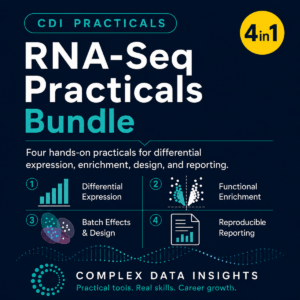
RNA-Seq Batch Effects and Experimental Design Practical
A hands-on exercise for recognizing batch effects, evaluating experimental designs, and building reliable RNA-Seq statistical models
RNA-Seq results depend not only on the analysis code, but also on how samples were collected, assigned to experimental groups, processed, and represented in the statistical model.
Batch effects can create apparent differences between samples that are unrelated to the biological question. Poor sample allocation can reduce statistical power, introduce bias, or make it impossible to separate biological effects from technical variation.
This practical helps you recognize these problems before interpreting differential expression results.
You will work with realistic RNA-Seq count data and three sample-metadata scenarios: balanced, imbalanced, and confounded experimental designs. You will inspect the relationship between condition and batch, visualize sample structure, compare statistical models, and learn when batch effects can be accounted for and when the study design prevents reliable estimation.
The practical is designed for learners, researchers, students, and early-career analysts who want to understand the connection between experimental design, statistical modelling, and trustworthy RNA-Seq conclusions.
What you will practise
You will work through a structured RNA-Seq statistics and experimental-design workflow that includes:
- importing an RNA-Seq count matrix and sample metadata
- checking sample names and metadata consistency
- examining condition and batch assignments
- creating sample-allocation tables
- distinguishing balanced, imbalanced, and confounded designs
- filtering genes with very low counts
- transforming count data for exploratory analysis
- using PCA to identify major sources of sample variation
- creating sample-distance heatmaps
- evaluating whether samples cluster by condition or batch
- building DESeq2 design formulas
- comparing models with and without batch adjustment
- assessing changes in estimated log2 fold changes
- recognizing model-matrix and confounding problems
- interpreting effect sizes, uncertainty, and adjusted p-values
- exporting statistical results and diagnostic figures
Experimental-design scenarios
The practical uses three realistic scenarios to demonstrate how sample allocation affects the analysis.
Balanced design
Each experimental condition is represented across the available batches. This allows the statistical model to estimate biological condition effects while accounting for technical batch variation.
Imbalanced design
Both conditions occur across batches, but the sample numbers are uneven. The model may still be estimable, although interpretation requires greater care because the design provides less balanced information.
Confounded design
Condition and batch overlap completely. For example, all control samples occur in one batch while all treatment samples occur in another. In this situation, the statistical model cannot determine whether the observed differences are caused by treatment or batch.
Figures and outputs
During the practical, you will generate useful statistical and experimental-design outputs such as:
- sample-allocation summary tables
- condition-by-batch contingency tables
- PCA plots colored by biological condition
- PCA plots colored by batch
- sample-distance heatmaps
- differential expression results from alternative models
- log2 fold-change comparison plots
- tables showing model-dependent changes in gene estimates
- quality-control and diagnostic outputs
- a structured experimental-design interpretation
These outputs can support research planning, statistical reporting, manuscript methods, teaching materials, portfolio evidence, and discussions with collaborators before a sequencing experiment begins.
Statistical interpretation
The practical explains statistical concepts that are often difficult for RNA-Seq learners to interpret, including:
- design formulas
- reference levels
- model coefficients
- effect sizes
- standard errors and uncertainty
- p-values and adjusted p-values
- multiple-testing correction
- statistical power
- independent biological replication
- confounding and model identifiability
- the difference between batch correction and batch adjustment
- the relationship between statistical significance and experimental design quality
You will learn why statistical software cannot repair every experimental-design problem and why metadata inspection should happen before differential expression results are interpreted.
Tools used
The workflow is completed in R using widely used packages, including:
- DESeq2
- ggplot2
- dplyr
- readr
- pheatmap
- tibble
The practical begins with an RNA-Seq count matrix and sample metadata. Raw FASTQ processing, alignment, and read-level quality control are intentionally excluded so that you can focus on experimental design, statistical modelling, and interpretation.
Who this practical is for
This practical is suitable for:
- undergraduate and postgraduate students
- researchers planning RNA-Seq experiments
- bioinformatics learners
- laboratory scientists working with sequencing studies
- data analysts entering omics research
- research teams reviewing sample metadata
- mentors and instructors teaching RNA-Seq statistics
Basic familiarity with R and RNA-Seq count data is helpful, but the workflow is written step by step and includes reusable code, realistic examples, statistical explanations, and interpretation guidance.
What you will complete
By the end of the practical, you will have:
- a reproducible workflow for evaluating RNA-Seq experimental designs
- a clearer understanding of batch effects and confounding
- experience building and comparing DESeq2 statistical models
- organized diagnostic tables and figures
- publication-ready PCA and sample-distance visualizations
- a structured interpretation of design quality and statistical reliability
- portfolio-ready evidence of practical RNA-Seq statistical skills
This is a browser-first CDI Practical that you can follow at your own pace and return to whenever you need a practical reference for RNA-Seq statistics, batch effects, and experimental design.