Description
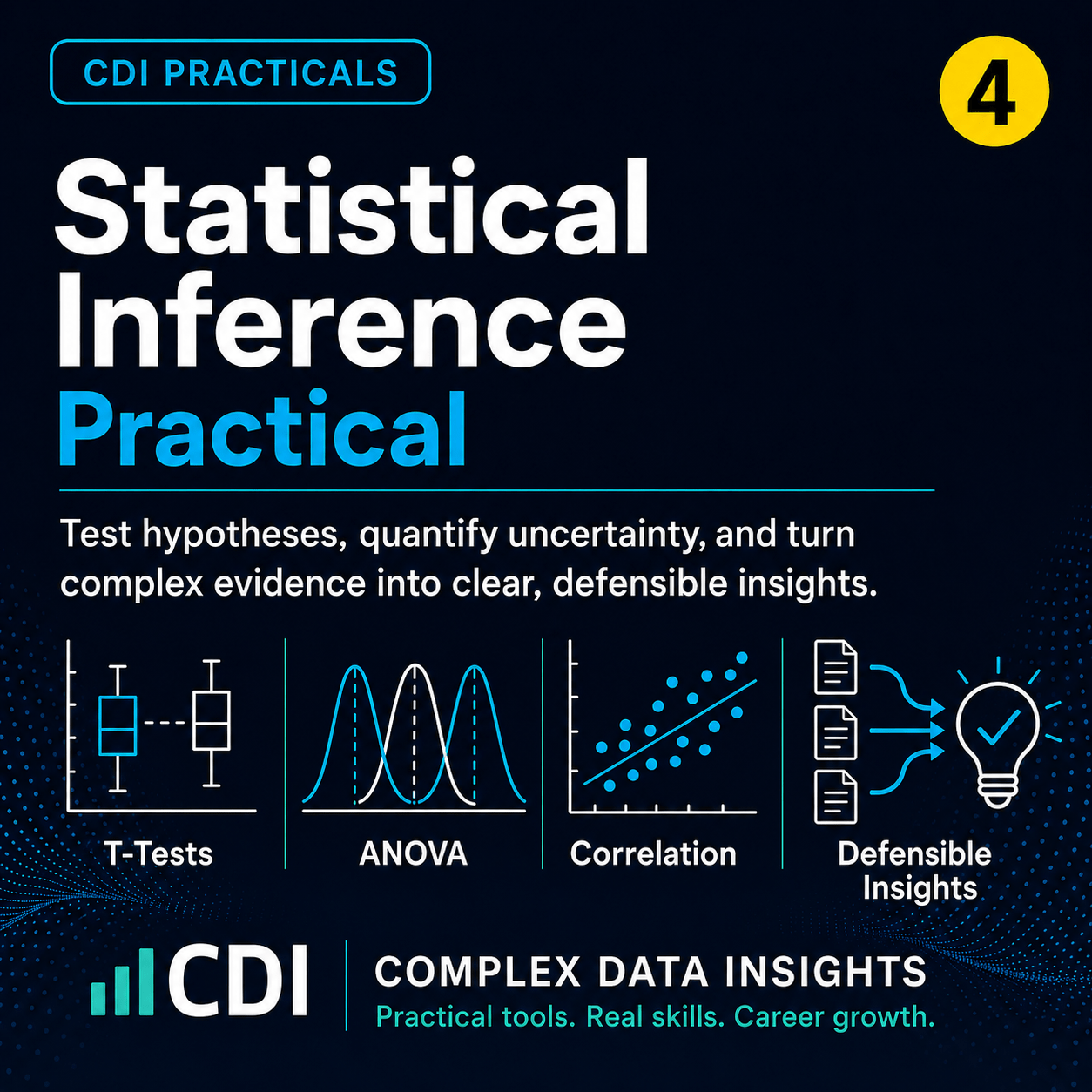
Statistical inference involves more than running a test. You must match the method to the research question and study design, assess assumptions, interpret uncertainty, distinguish statistical significance from practical importance, and avoid claiming more than the evidence supports.
The Statistical Inference Practical guides you through this complete reasoning process using Python and a realistic synthetic service-delivery dataset. The data include three service models, four regions, baseline and follow-up outcomes, wait times, satisfaction scores, completion status, unequal sample sizes, missing values, and possible confounding.
Instead of working through disconnected textbook examples, you will apply multiple methods to one connected analytical question:
Which service model produces the strongest outcomes, for whom, and how confidently can that conclusion be defended?
What You Will Practise
- One-sample t-tests against meaningful benchmarks
- Welch independent-samples t-tests
- Paired t-tests for baseline and follow-up measurements
- One-way ANOVA across three service models
- Tukey HSD post-hoc comparisons
- Pearson and Spearman correlation tests
- Chi-square tests of independence
- Confidence intervals and effect sizes
- Graphical and formal assumption checks
- Mann–Whitney U, Wilcoxon signed-rank, and Kruskal–Wallis sensitivity analyses
- Holm correction for multiple testing
- Explicit reject or fail-to-reject decisions
- Plain-language interpretation and responsible reporting
More Than a Collection of Tests
Each analysis follows a reusable CDI reasoning framework:
- Ask the research question.
- Identify the variables and study design.
- State the null and alternative hypotheses.
- Select and justify the method.
- Check assumptions and limitations.
- Run the analysis.
- Report the estimate, confidence interval, statistic, and p-value.
- Evaluate effect size and practical importance.
- Reject or fail to reject the null hypothesis.
- Translate the result into a defensible insight.
This consistent structure helps turn statistical reasoning into a clear, repeatable analytical habit.
Professional Outputs
By the end of the practical, you will have a complete evidence package containing:
- dataset profile and descriptive statistics;
- assumption-check results;
- t-test, ANOVA, correlation, and chi-square evidence;
- Tukey-adjusted group comparisons;
- non-parametric sensitivity results;
- multiple-testing-adjusted decisions;
- analytical figures and diagnostics;
- a hypothesis decision register; and
- a CDI Insight Brief connecting the evidence to a proportionate recommendation.
The CDI Difference
This practical goes beyond p < 0.05. You will learn to explain:
- what the result means in plain language;
- whether the effect is large enough to matter;
- how assumptions and missing data affect confidence;
- whether different methods tell a consistent story;
- which alternative explanations remain plausible;
- what action the evidence supports; and
- which claims the analysis cannot support.
Who This Practical Is For
- Researchers seeking clearer guidance on statistical test selection and interpretation
- Postgraduate students strengthening applied statistical reasoning
- Data analysts moving beyond descriptive summaries
- Health, social, biological, and service researchers working with mixed outcome types
- Python users seeking an end-to-end, reproducible inference workflow
Prerequisites
Basic familiarity with Python and pandas is helpful. Statistical reasoning is explained step by step, with reproducible scripts and tested project files supplied. Python 3.10 or later and Quarto are recommended.
Included
- Online step-by-step CDI Practical
- Downloadable project files
- Reproducible synthetic dataset generator
- Complete Python analysis runner
- Bash one-command workflow
- Reference outputs, figures, and tables
- Reusable hypothesis-decision and insight frameworks