Description
Turn a cleaned dataset into clear, defensible exploratory evidence
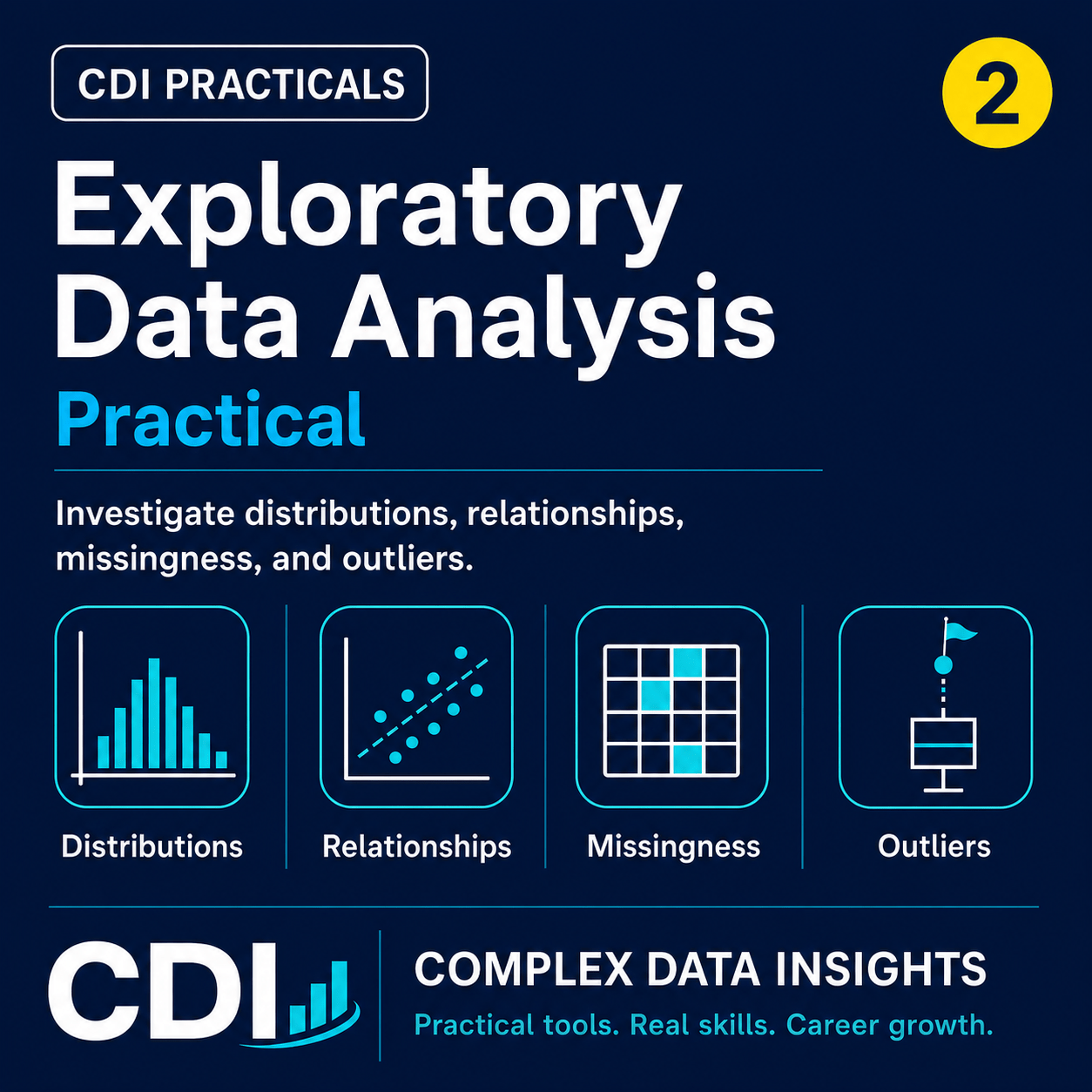
A cleaned dataset is only the starting point. Before modelling, reporting, or making decisions, you need to understand what the data contains, identify important patterns and unusual observations, assess missingness, compare groups, examine relationships, and communicate what the evidence can—and cannot—support.
In this hands-on CDI Practical, you will use Python to complete an end-to-end exploratory data analysis (EDA) project with a realistic synthetic service-delivery dataset. You will move from dataset orientation and explicit exploratory questions to reproducible summaries, visualizations, interpretation, limitations, and a professional evidence package.
By the end, you will have completed a responsible exploratory workflow and created tables, figures, findings, quality checks, and portfolio-ready evidence that clearly document what you discovered.
What you will practise
- Formulating useful exploratory questions before analysing the data
- Confirming dataset structure, variable roles, types, and analysis readiness
- Creating a concise dataset profile and overview
- Summarizing numerical and categorical variables reproducibly
- Examining numerical distributions and categorical patterns
- Investigating missingness overall and across groups
- Identifying potential outliers without automatically treating them as errors
- Exploring temporal patterns in service records
- Comparing satisfaction and other measures across service groups
- Examining numerical and categorical relationships
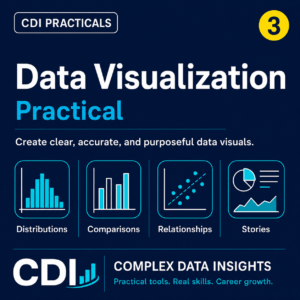
- Building a focused exploratory visual summary
- Separating description, interpretation, and unsupported causal explanation
- Recording findings, uncertainty, limitations, and possible next analyses
- Verifying and presenting a reproducible exploratory evidence package
What you will produce
- An exploratory analysis plan with clearly stated questions
- A dataset overview and analysis-readiness checks
- Numerical and categorical summary tables
- A temporal summary of service records
- Missingness and potential-outlier review tables
- Distribution and categorical-pattern figures
- Grouped-comparison and relationship figures
- An exploratory visual summary
- A structured findings table
- An interpretation and limitations statement
- Quality-control evidence and a reproducibility manifest
- A portfolio-ready project summary
What is included
- A browser-based, step-by-step CDI Practical
- A realistic synthetic cleaned service-delivery dataset
- Complete Python code used throughout the guided practical
- Guided questions, interpretation prompts, and professional decision points
- Author-generated reference tables, figures, and quality-control outputs
- Optional Python utilities for regenerating the dataset and reference results
- A requirements file for creating a dedicated Python environment
- Access through the download links supplied after purchase
- The option to save a personal PDF copy using your browser’s Print → Save as PDF feature
Who this practical is for
- Data science and data analysis learners
- Students and researchers working with tabular data
- Monitoring, evaluation, and programme professionals
- Professionals strengthening their exploratory analysis skills
- Learners building credible evidence for a data portfolio
What you need
- Python 3.10 or later
- VS Code with the Python and Jupyter extensions, or another Python environment
- Basic familiarity with Python and tabular data
- No advanced statistics or machine-learning experience
Important information
The practical uses synthetic data created for learning. It contains no real participant or client records.
Exploratory patterns are treated as evidence for further investigation, not proof of causation.
This is a digital product. No physical item will be shipped.